Don’t feel like reading? Scroll to the bottom for a TL;DR.
The thing I love about any game with roguelike aspects is its replay value. Combine variety in gameplay with a charming aesthetic, and you got yourself spending days to weeks experimenting with the game’s mechanics. For me, it gets exhausting knowing there’s always more to play around with. And that’s how Griftlands grabs me by the neck and asks me if I want more. And of course, I say “yes daddy” and then pass out.
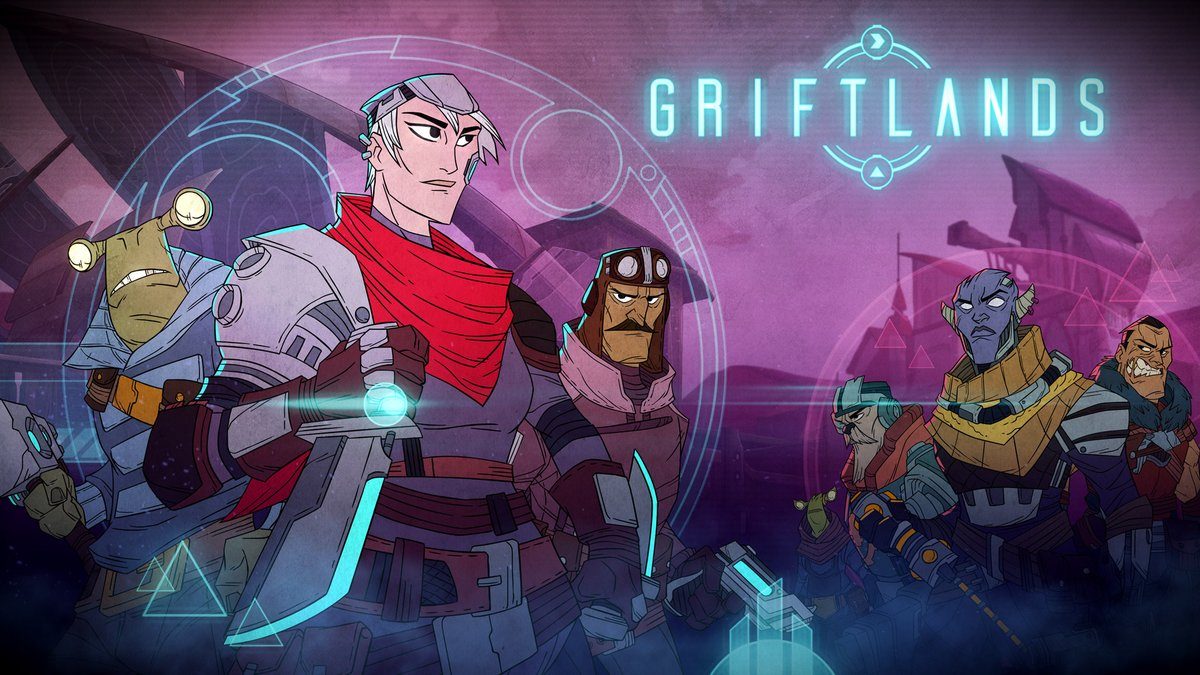
Developed by Klei, Griftlands is a card-based RPG that follows their proven track record of “fun roguelites with strong visuals.” The hand-drawn angular art style is striking, and the characters are well-animated with their own special brand of gibberish voice acting. But what really sets it apart from games like Slay the Spire or Darkest Dungeon is its major focus on story and its interesting divide in gameplay.
Three Personalities, Three Fun-Filled Adventures

Your three playable dumb-dumbs
Set in a dystopian Mad Max-ish cyberpunk world, you’re given the option of playing three different characters—each with their own story campaign. There’s Sal: a recently freed prisoner out for revenge, Smith: the black sheep son of an affluent family, and Rook: a retired police officer looking to get ahead through less than wholesome means. Through each campaign, you discover more about the setting of Griftlands and the various politics that surround it. Between cults, corrupt police, employer vs laborer disputes, and more, the world is colorful and ready to be explored.
Whichever character you pick, you’re given both minor and major choices that affect the gameplay, plot, and overall ending of your campaign. Who you ally with and betray, who you kill or spare, what you buy or steal all have some kind of effect. You won’t be able to encounter every event in a single run, but like any good roguelite, that’s what keeps the game fresh.

Do You Wanna Talk it Out Or Catch These Hands
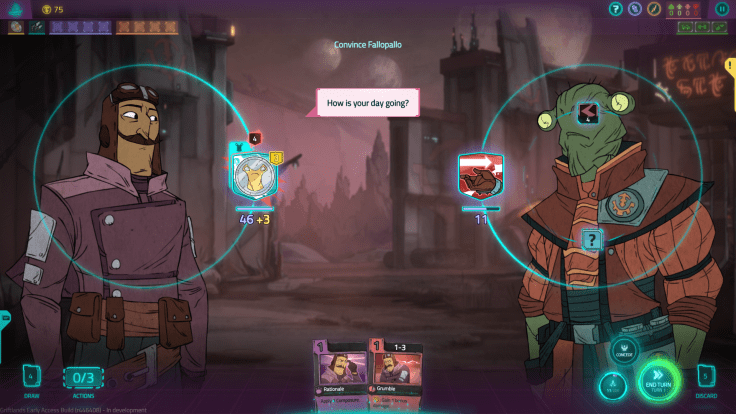


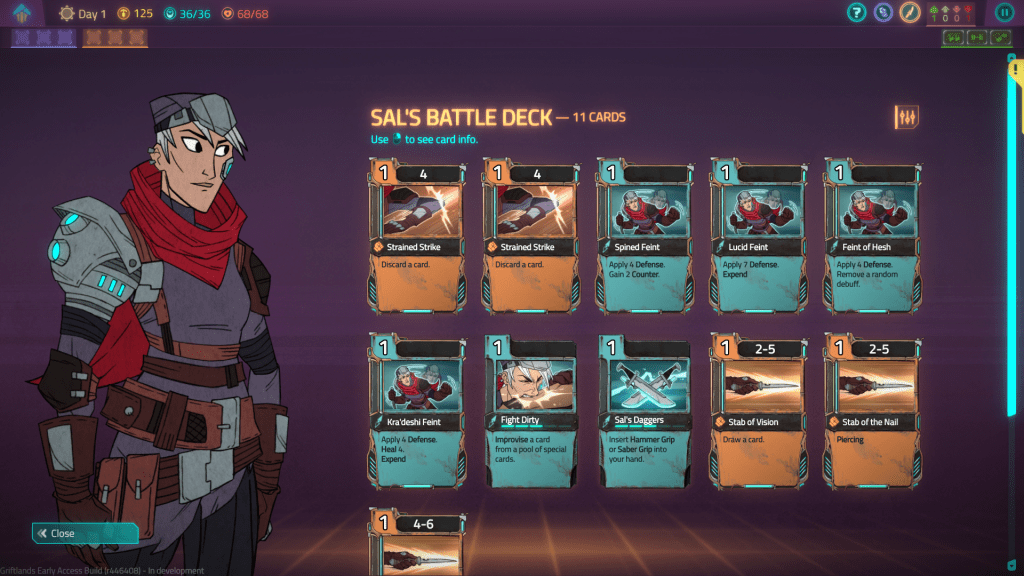
At the beginning of a campaign, you’re given a negotiation deck and a battle deck. As you play, you’re rewarded with specific cards and upgrades depending on which mode you play in. The progression system is set up in a way that you’ll most likely become more powerful with one mode than the other. As a result, the challenge in balancing the power of your negotiation and battle decks becomes a major part of finishing a run.
That said, the amount of deck experimentation with just one character is practically endless. The game incentivizes you to play around with different strategies since situations are so varied. Adding on to that is the fact that all three characters have completely different card sets. As a result, their styles in gameplay differ drastically. Through all this, you can spend hours upon hours of creating different decks to see what will fit your playstyle. Finding out what worked and what didn’t was a major highlight for me.
Story and Gameplay Intertwine A Little Too Much

What Klei does so well with this game in particular is the dynamic between story and gameplay. I don’t just mean how your choices affect the plot, but the fact that how you play transforms your character and the world of Griftlands. Whether you play as a pacifist or a blood-thirsty serial killer, the game rewards and punishes you for almost any action you take.
Still, roguelites can only have so much variety. Things get repetitive over a number of runs, and it’s easy to fall out of love with the setting once you’ve seen every scenario and piece of dialogue the game has to offer (it also gets tiresome seeing every single character have an identical set of animations). Ultimately, the gameplay was what kept me hooked, and the story became a non-factor. I don’t think that’s Klei’s fault so much as how roguelites are naturally designed. Stories with concrete endings don’t mesh well with games that are inherently meant to be endless.
Fortunately, the game isn’t fully done yet. Griftlands is currently in Early Access on Steam, and is being constantly updated with new features, modes, and balance changes. While that doesn’t fix the gripe I mentioned above, I’m excited to see what new scenarios the developers plan on adding on top of all the content they’ve already given us.
TL;DR

Griftlands has almost endless replay value with it’s deck-building and varying modes of gameplay. If you like deck-building games, Mad Max-ish dystopian settings, a great art style, and branching storylines, you might get hooked on this game if you give it a try.
 The Dang Void